Sanitation System
A Proven Standard for Safe Sanitation
The Safe Water Garden (SWG) is a single-sized sanitation system suitable for small schools and family groups in tropical villages worldwide. It is safe, maintenance-free, and highly affordable. Communities can build it themselves within a single day.

Water safety
- Closed-loop wastewater treatment with a liquefier tank
- The wastewater is recycled safely back to the local water table, addressing a key national objective to protect local water sources
- No odors, no exposed waste, no health risks
Simple construction
- Made with a widely available 500-liter PE drum, plastic pipes, gravel, and sand
- Can be installed by villagers in half a day
- Villagers only need a hoe, shovels, a saw, and a regular drill to drill holes in the drums and the pipes
- No machines, chemicals, or special skills are needed
Household ownership
- Wholly owned by the end users
- Addressing a key wish of village communities worldwide to own their own utilities to the maximum extent possible; village communities worldwide express aversion to communal systems or systems they have no control over
- Cheaper even than the traditional sub-standard soak pits, the Safe Water Garden system is affordable to village communities
- The average cost of $250 per household falls within the annual village budget
- Most families are able to (co)finance such amounts if given access to microloans
Local livelihoods
- Unlocks sustainable income through a dignified home where one can conduct business
- Catalyzes micro-farming, healthy food habits, and micro-businesses
- Having dignified WASH reverses the rural-urban exodus
- Village families no longer feel their children must escape the indignity that comes with substandard WASH
Notable milestones and achievements for Safe Water Gardens
- 2019 – Certified as a safe sanitation system by the Indonesian government
- 2023 – Exhibited at the UN Water Conference in New York as one of only six scalable WASH innovations
- 2025 – Globally recognised as a safe sanitation system by Finish Mondial, the world’s largest sanitation NGO
- 2025 – In his keynote speech at the international conference on decentralized wastewater systems hosted by the Government of Japan, Dr. Roshan Raj Shrestha of the Gates Foundation lauded the SWG as the only system that avoids all known pitfalls associated with rural sanitation.
Core criteria for safe sanitation
When we launched the project in 2016 together with three renowned universities, we identified three primary barriers to universal safe sanitation: affordability, accessibility, and sustainability. To overcome these obstacles, we developed both a sanitation system and a distribution model.
Affordability
The SWG is cost-efficient and requires no maintenance.
Accessibility
The SWG can be installed in villages everywhere, even at remote houses, as long as there is a little garden space.
Sustainability
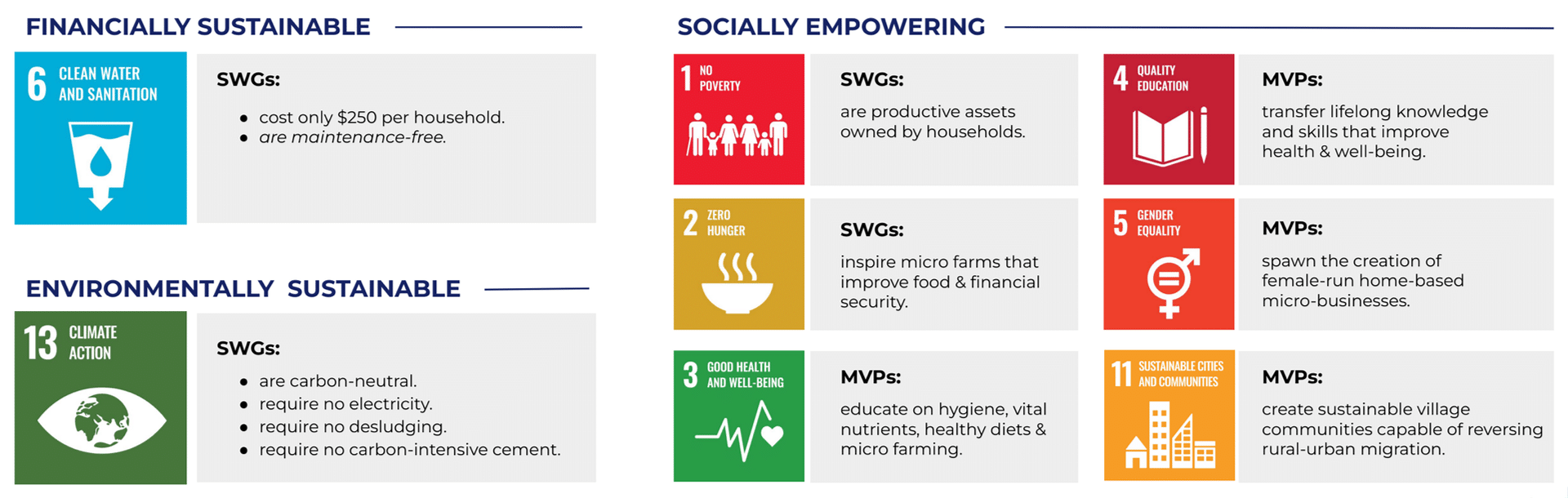
The SWG is financially, socially, and environmentally sustainable.
How Safe Water Gardens meets all criteria
Affordability
The SWG and its social engagement model are the result of a two-year research project with three leading universities. In 2019, the Indonesian government officially certified the SWG as a safe sanitation system. That made it the world’s most affordable safe sanitation solution for tropical and subtropical villages.
By design, the SWG is the lowest-cost option that meets all requirements of a safe sanitation system. At less than $250 per household on average,* it fits within annual village budgets for sanitation – at a time when fewer than 5% of Indonesian village families have access to safe sanitation.
* Based on 2–3 households sharing a Safe Water Garden
Accessibility
Government-led communal approaches typically rely on heavy machinery such as bulldozers, which cannot reach many homes. The Safe Water Garden system, by contrast, can be installed in any location with a small garden space.
All required materials are deliberately chosen to be locally available: drums and pipes are readily available, as are sand and gravel. The villagers themselves carry out the installation; no external expertise is needed.
Sustainability
The Safe Water Garden system sets new standards in sustainability:
- Technically, it is easy to install with locally available materials. It operates as a fully water-circular, nature-based system, and it functions indefinitely without maintenance.
- Socially, it aligns with the rural aspiration to own household utilities.
- Financially, sustainability is achieved through the distribution via our Model Village Project (MVP).
The MVP program enables one village in each tribal district to become the local WASH* competence center, where neighbouring villages learn how to install safe, affordable WASH systems.
The communities themselves can cover the total cost of around $500 per household for complete WASH: village funds can cover the cost of safe sanitation (around $250 per household), while village families can take out a microloan for the remaining $250 to install running water and clean drinking water.
* WASH = Water Access, Sanitation, and Hygiene
Comparison of our system
A Safe Water Garden is an entirely circular, nature-based solution that returns treated wastewater to the local water table.
Safe Water Garden | Government communal system (SANIMAS)* |
|---|---|
💚 Environmental benefit | * Indonesia’s predominant rural communal system
Validated by research
Based on a prior UNICEF initiative, the Safe Water Garden’s design and social engagement model stems from a two-year research project conducted jointly with our academic partners and funded by a Dutch government grant (Nuffic).

Indonesia’s oldest and largest higher education institution, featuring 18 faculties, 27 research centers, 55,000 students, and 2,500 faculty members.

Ranked third among all European research universities, TU/e secured a Dutch government research grant to support this project.

A Singapore-based university whose Environmental Research Institute (NERI) specializes in R&D on water and wastewater infrastructure in the region.

A private, technology-focused university in Bandung, Indonesia, known for its world-class reputation in environmental engineering.

Technical documentation
A detailed overview of the system’s scientific basis, design principles, and regulatory compliance.
Learn more about our sanitation solution
If you have questions about the Safe Water Garden system and how it can improve health, dignity, and livelihoods in tropical village communities, we look forward to hearing from you.